
NetSuite Reimplementation Methodology: What LST Consultancy’s Approach Includes
NetSuite Reimplementation Methodology: What LST Consultancy’s Approach Includes
If your NetSuite system fails to deliver the expected results, a complete reimplementation may be the answer. However, most organizations overlook a critical factor: the approach you take during reimplementation is just as important as the decision to reimplement. The distinction between a successful reimplementation and an expensive failure typically depends on the methodology your implementation partner employs.
At LST Consultancy, we helped 50+ companies successfully Reimplement NetSuite and transform their ERP systems. In this guide, we’re sharing the details of what a structured reimplementation methodology looks like – and how it enables your business to continue operations unabated (while propelling) with more advanced systems.
Why Methodology Matters in NetSuite Reimplementation
A structured methodology is not merely a choice – it is necessary. Organizations that collaborate with implementation partners who adhere to systematic processes will encounter:
Without structure, you have projects that waver, slip timelines, and break the bank, precisely what it looked like in those failed implementations to avoid.
- ✓Reliable timelines: You can plan to go-live and what it will be like
- ✓Fewer surprises: Problems reveal themselves in a controlled testing environment, not during mission-critical operations
- ✓Speed of adoption: Efficient change management gets the teams on board for the new system
- ✓Cost savings: If you fail to plan well, the risk of cost overruns from unstated requirements that can lead to scope creep and rework is high.
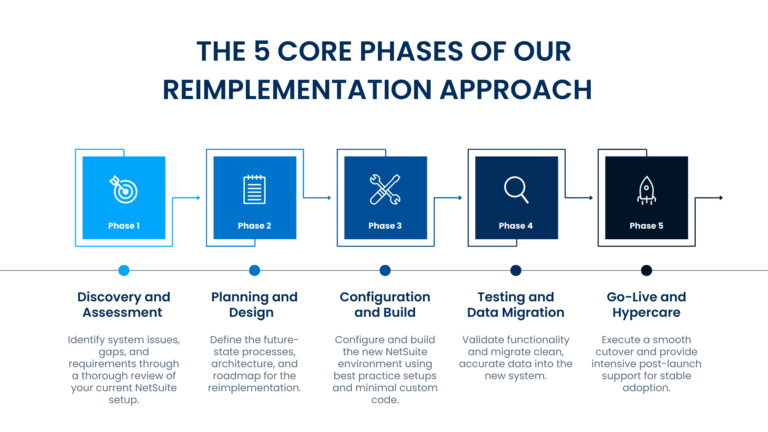
The 5 Core Phases of Our Reimplementation Approach
We evaluate your existing NetSuite system in detail. What we look at is what they are using, what’s being customized, your data quality problem today, and where your team has pain.
What happens during discovery:
You will know where problems came from and what success looks like by the time you complete discovery.
List timelines, roles, success metrics, and your future-state system architecture. This phase helps determine what must be constructed, what can be configured, and which legacy processes should be decommissioned.
Key deliverables:
A little planning now can save weeks of delay later.
Our team sets up NetSuite based on design requirements, prioritizing the use of standard features and functionalities first. We set up your chart of accounts, security rules, financial structure, and automation using SuiteFlow. We resort to custom code only when the standard solution is inadequate for solving a business problem.
This emphasis on configuration and modularity ensures that your system is maintainable and upgradable — no technical debt, which drove reimplementation.
Activities during build:
During this phase, we maintain a sandbox so you can track progress, test functionality, and submit feedback before anything touches production.
We conduct multiple testing types: unit testing (does this work when you configure that?), integration testing (are systems communicating properly?), and user acceptance testing (does this fix your business problem?). We also do a lot of data migration work, cleaning up legacy data as it is migrated to NetSuite.
Testing activities:
Issues are detected and resolved before they impact your business.
Structured cutover plan. We’re turning you on, and it’s going to be switch-flipping’ smooth… We’ll move your business from prehistoric systems into the NetSuite. Static data (chart of accounts, vendor master) is transitioned in advance. Dynamic data (open orders, inventory) is moved to the very end to minimize it.
For the first 30 days post-go-live, we’ll be embedded with your team. We track performance, respond to potential user inquiries, and address service issues before they affect service delivery. We follow adoption metrics and provide focused training where teams struggle.
Go-live phase includes:
Phase 1: Discovery & Assessment
NetSuite Reimplementation success begins with knowing where you are today.
Phase 2: Planning and Design
Let’s now sketch the very different path to your re-implementation.
Phase 3: Configuration & Build
This is where your reimplemented system will be built.
Phase 4: Testing & Data Migration
Testing occurs throughout development but becomes more organized and methodical currently.
Phase 5: Go-Live & Hypercare
Go-live isn’t the finish line—it’s the most critical part of winning.
Why LST Consultancy’s Approach Works
Our approach is based on solid core principles validated across dozens of successful rollouts:
- Systematic Risk Management: Problems arise under control, not production.
- User-Centric Design: We engage your team from discovery through training, fostering ownership and increasing adoption.
- Configuration-First: We make as few difficult-to-maintain customizations as possible.
- Structured Governance: Clearly defined roles, regular meetings, and documentation of decisions keep projects on course.
- Hypercare Commitment: We keep skin in the game through go-live and critical stabilization; we don’t hand off when you really need us.
Timeline & Resource Expectations
Your reimplementation length depends on complexity:
You’ll need dedicated resources:A project sponsor (a member of the C-level management), a project manager, and specialists from finance, operations, and IT.
- Simple implementations– 4-5 months (single organisation, few customisations)
- Standard implementations– 6–8 months (several sites, medium integration). Gain quick control over product data usability.
- Complex implementations– 9-12+ months (multiple divisions, deep customization)
Move Forward with Confidence
Reimplementation is a big deal, but when done right, it changes the way your business operates. A defined methodology removes the guesswork, ensuring your investment delivers results.
At LST Consultancy, we’ve developed our own proven approach to higher education over the years in the trenches, through best-of-breed practices, and through very frank client dialogues. We’re believers in open communication, a methodical approach, and dedication to your success long after go-live.
Ready to explore whether reimplementation is right for your business?
Get in touch with LST Consultancy for a free NetSuite health check and implementation roadmap. Will explain your options to you and demonstrate what a successful reimplementation looks like for your organization.
Your next chapter in ERP success starts with a clear plan. Let’s build one together.
Frequently Asked Questions (FAQs)
When would a company consider reimplementation of NetSuite?
A NetSuite reimplementation is necessary when the existing configuration can no longer adapt to business processes, there are many customizations, or production bottlenecks.
How Long Does It Take to Reimplement NetSuite?
Most NetSuite reimplementation projects are completed within 4–12 months, depending on the system’s size and the level of customization.
What are the advantages of NetSuite reimplementation?
A good NetSuite reimplementation brings cleaner processes, more accurate data, less technical debt, and greater user adoption.
What about my data during implementation?
Yes. The critical data is migrated (once it has been cleaned and validated) during your NetSuite migration to ensure the system being implemented contains authentic data.
The role of change management in NetSuite reimplementation
Absolutely. A solid change management strategy empowers users to adapt to new workflows and ensures a seamless post-reimplementation.